
William Hill in Guyana: licence and complaint evidence
Complaint chronology and present verdict
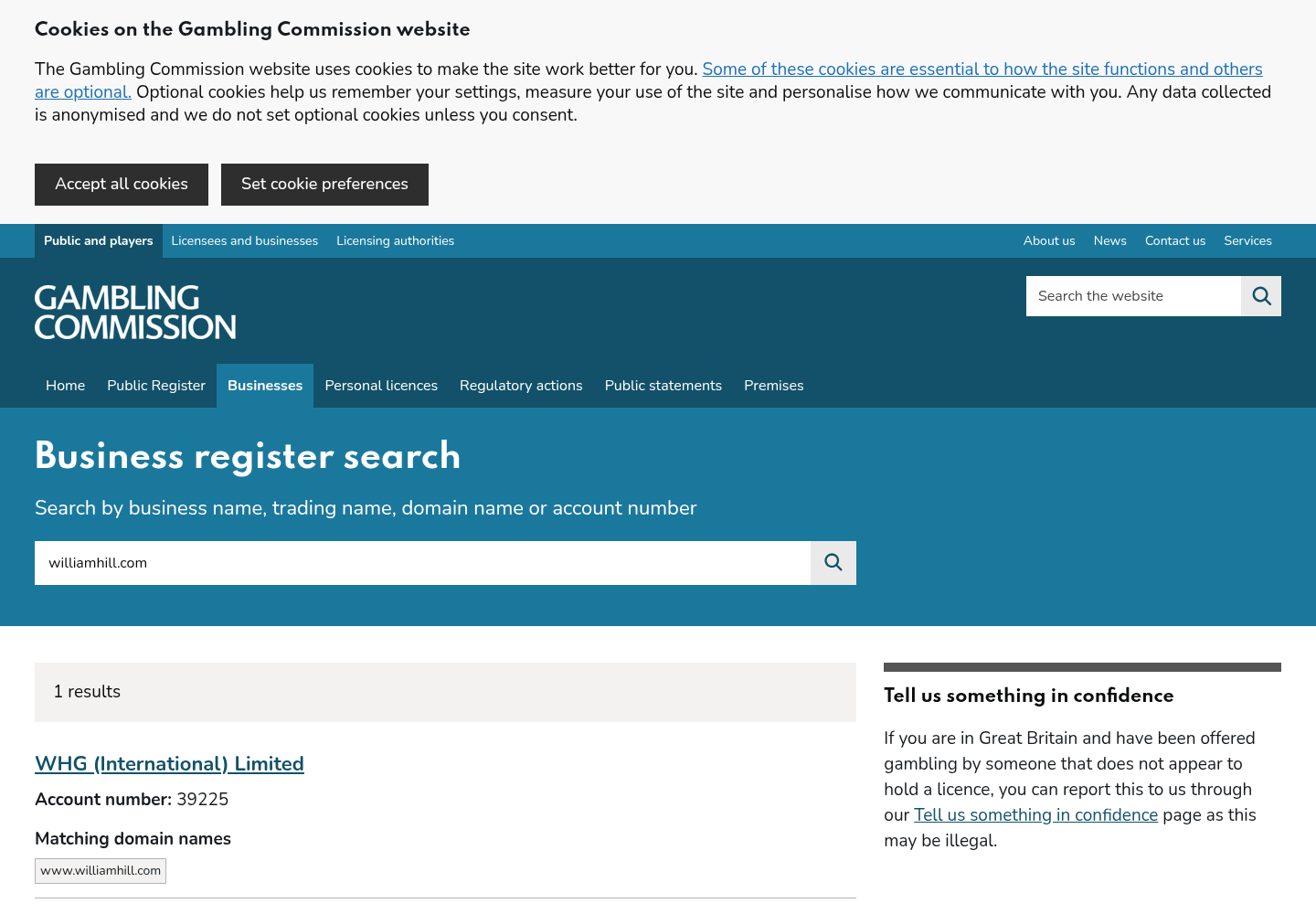
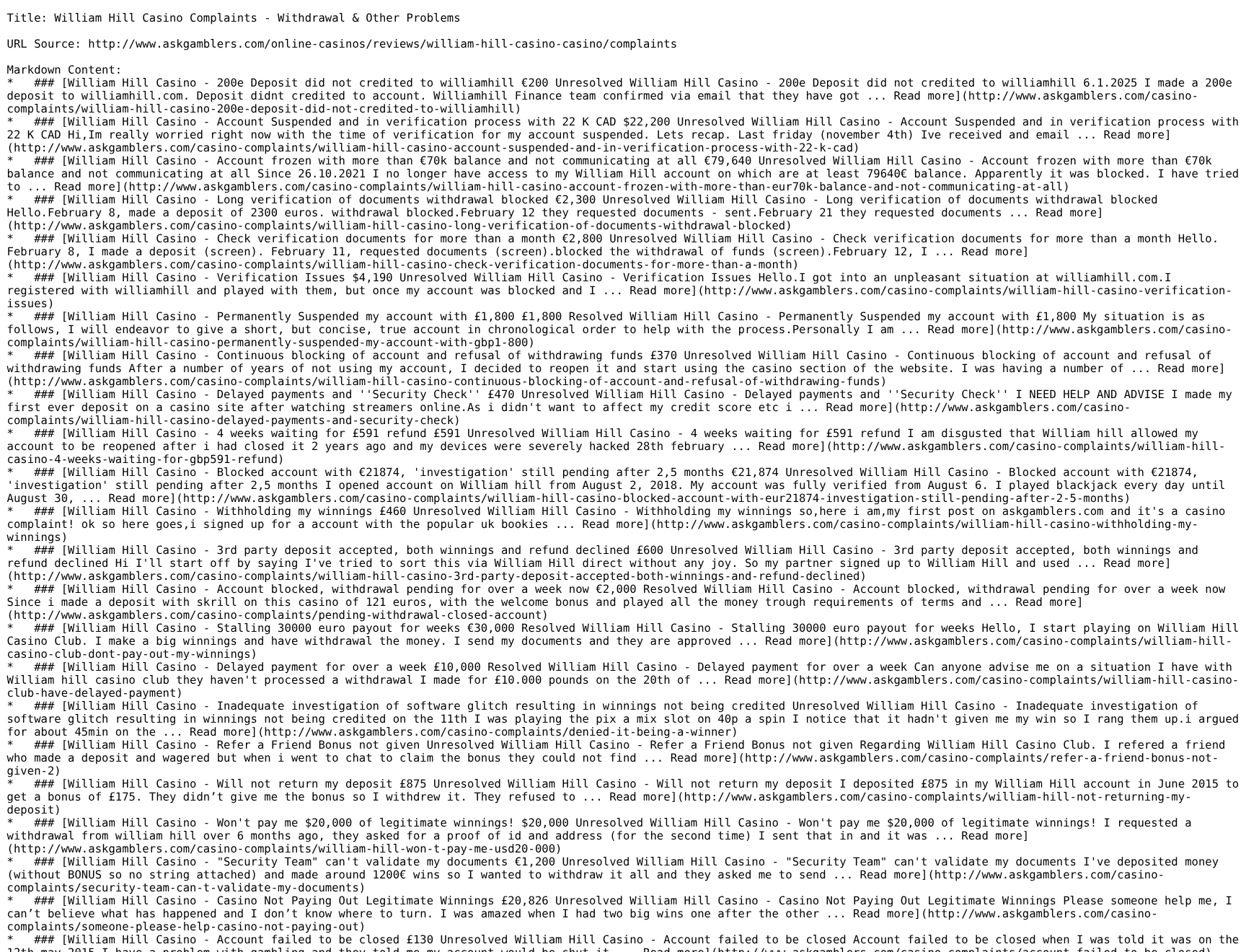
The evidence begins with two checks completed on 24 August 2026, but the records serve different purposes. A UK Gambling Commission register search associates williamhill.com with a GB-licensed entity. A separate capture identifies a public complaint-list location concerning the casino. Those complaints remain allegations or contextual reports unless an appropriate authority or a documented resolution establishes what happened.
| Date | Record checked | What it establishes | What it does not establish |
|---|---|---|---|
| 2007 | Gambling Prevention (Amendment) Act | Guyanese law introduced casino-premises and casino-operator licensing concepts | It does not name this service or authorise its website |
| 24 August 2026 | UK Gambling Commission register search | The exact domain appears in a search connected with a GB-licensed entity | It does not prove a Guyana licence or local availability |
| 24 August 2026 | Complaint-list capture | A complaint-list location exists for the casino | It does not prove every allegation, a current pattern, or wrongdoing |
The resulting signal is amber. There is meaningful identity evidence and a current primary register result, but the supplied records do not establish that the service holds a Guyana licence. Historical official enforcement or regulatory history also cannot be converted into a current finding without the relevant dated record. The defensible answer to “William Hill scam or legit Guyana?” is therefore conditional: the supplied material supports a real domain and an identifiable regulated relationship in Great Britain, but it does not resolve local authorisation, current access, payments, withdrawals or individual complaints in Guyana.

Exact domain, operator and licence match
Three separate questions must be kept apart: whether the domain is correctly identified, whether an entity is associated with it, and whether that association gives permission to serve players in Guyana. The supplied UK Gambling Commission search is useful for the first two questions. It was checked against the exact domain williamhill.com and reports an association with a GB-licensed entity. The operator named in the packet is WHG (International) Limited.
The record should not be stretched further. A Great Britain register entry is not a Guyanese licence, and no licence number, licence expiry date or Guyana-specific authorisation was supplied. The absence of an expiry date in the packet should be recorded as unknown rather than interpreted as perpetual validity. Likewise, an operator name in a dossier does not prove that every page, application, mirror or payment descriptor using similar branding belongs to that entity.
| Identity element | Supplied result | Confidence and limit |
|---|---|---|
| Exact domain | williamhill.com | Supported by the dated UK register search |
| Named operator | WHG (International) Limited | Supplied as the associated operator; verify against the live register before relying on it |
| Regulatory record | UK Gambling Commission public register | Relevant to Great Britain, not proof of a Guyana licence |
| Guyana licence | Not supplied | Must remain unresolved |
| Licence expiry | Not supplied | No date should be inferred |
The primary identity check is the UK Gambling Commission register result. Compare the spelling of the full domain, the named legal entity and any listed trading names. A match on the brand alone is weaker because clone sites can reproduce names, colours and images. A mismatch in even one domain character should halt registration or payment until independently resolved.
Legal position for a player in Guyana
The legal evidence is narrower than the identity evidence. Guyana’s Gambling Prevention (Amendment) Act 2007 created concepts for licensing casino premises and casino operators. That shows that casino licensing has a statutory basis, but the supplied Act record does not identify the online service, its domain or WHG (International) Limited as a Guyana licensee.
The Gambling Prevention (Amendment) Act 2007 should therefore be read as legal background, not as an approval list. Nothing in the accepted packet confirms whether online play through this overseas domain is offered lawfully to a person physically located in Guyana, whether access is contractually accepted, or which local authority would handle a remote-gambling dispute.
| Legal question | Evidence available | Dossier conclusion |
|---|---|---|
| Does Guyanese law recognise casino licensing concepts? | Yes, through the supplied 2007 amendment record | Confirmed only at that general level |
| Is the exact domain licensed in Guyana? | No Guyana register record was supplied | Unresolved |
| Does a GB record authorise Guyana play? | No such link was established | Do not treat it as local permission |
| Is access from Guyana currently accepted? | No dated availability test or operator statement was supplied | Unknown |
| Which rules govern an individual account? | No accepted terms or account record was supplied | Must be checked before depositing |
A cautious player should review the local-law overview under legal information, then confirm current eligibility and contractual jurisdiction before creating an account. Geolocation access by itself proves little: a website loading, a registration form accepting details, or a payment screen appearing does not establish legal permission. Conversely, the lack of a supplied Guyana licence record is not by itself proof of fraud. It is the reason for the amber rather than green assessment.
Scam or legitimate: what the records can support
The word “scam” requires stronger evidence than an unresolved complaint, a failed payment or uncertainty about local licensing. No official adverse finding establishing current fraud was supplied. The record also does not support an unqualified “legitimate in Guyana” verdict, because no current primary evidence ties the exact domain and operator to Guyanese authorisation.
The strongest positive signal is identity traceability: the exact domain can be checked in a competent foreign regulator’s public register. The strongest limitation is jurisdiction: that record concerns Great Britain, while the intended player is in Guyana. Complaint material adds questions worth investigating but cannot independently settle them.
| Signal | Present finding | Reason |
|---|---|---|
| Green | Not justified | No current Guyana-specific primary authorisation was supplied |
| Amber | Appropriate | Identity evidence exists, but local status and operational facts remain open |
| Red | Not justified on this packet | No supplied official adverse record or corroborated current fraud evidence meets the threshold |
The practical conclusion is to verify rather than assume. Confirm the exact address, legal entity, eligible country, applicable terms, account currency and complaint body before sending money. Do not rely on a search advertisement, social-media message, copied logo or unsolicited “account manager”. If any representative requests payment to a personal account, cryptocurrency transfer to an unverified wallet, remote-device access, or an extra fee to release a withdrawal, stop and preserve the communication for a complaint.
Payments, withdrawals and identity checks
No accepted source states which deposit methods, withdrawal methods or currencies are currently available to a customer in Guyana. There is also no documented deposit or withdrawal test. It would therefore be misleading to list cards, bank transfer, electronic wallets, cryptocurrency, processing times, fees or limits as confirmed features.
Before depositing, capture the cashier terms shown inside the verified domain and record the currency, minimum and maximum amounts, stated fee, withdrawal destination rule and estimated processing period. Keep the payment receipt and the exact descriptor appearing on the statement. The payments guide can be used as a checklist, but it does not turn an unverified method into a supported fact for this operator.
| Transaction stage | Evidence status | Safer check |
|---|---|---|
| Deposit methods | Unknown for Guyana | Read the verified cashier before authorising payment |
| Withdrawal methods | Unknown | Confirm whether funds must return to the original source |
| Processing time | No tested or sourced result | Save the stated timeframe before submitting the request |
| Fees and exchange rate | Not supplied | Record both operator and payment-provider charges |
| Withdrawal success | No test exists | Do not claim a successful payout based on this dossier |
| Account currency | Not supplied | Check conversion terms before depositing Guyana dollars |
Identity verification, often called KYC, is also unresolved in the evidence packet. No document list, verification time or source-of-funds threshold was supplied. A legitimate verification request can still create privacy and delay risks, so submit documents only through a securely verified account channel. Check what entity receives the data, why it is needed, how it may be retained and whether sensitive numbers can be masked where permitted. Never send identity documents to an address obtained only from a message or advertisement.
For withdrawals, save the submission time, status changes and every request for additional information. If the stated processing window passes, ask for a written reason and a case reference. Do not cancel and resubmit repeatedly unless support explains the effect, because that can complicate the timeline. Avoid depositing more money merely because someone says it is required to unlock an existing balance.
Complaint evidence and escalation gates
The supplied independent capture identifies a complaint-list location concerning William Hill. Its existence is relevant for discovering issue types and questions to ask, but submissions by users are allegations. They may be incomplete, disputed, duplicated, resolved later or related to another jurisdiction or product. Aggregate impressions are not a substitute for account records or a regulator’s decision.
The captured complaint listing should be treated as context only. It does not prove that a particular complaint is true or that a reported outcome predicts another player’s result.
A personal dispute should move through evidence gates. First, create a clean chronology containing registration, verification, deposit, wager, withdrawal and support-contact times. Second, send a concise complaint through the verified service channel and request a case number. Third, use the operator’s formal complaint procedure and preserve its final response or deadlock communication. Fourth, identify the dispute body or regulator actually named in the applicable account terms; do not assume that a Great Britain route covers a Guyana-based account.
| Escalation gate | Evidence to retain | Move forward when |
|---|---|---|
| Support request | Message, timestamp, account reference and requested remedy | The normal response period expires or the answer is inadequate |
| Formal complaint | Full chronology, transaction proof and relevant terms | A final response arrives or the published complaint period passes |
| External escalation | Final response, jurisdiction clause and complete file | The named body confirms it can consider the account |
| Payment dispute | Statement, authorisation details and correspondence | The payment provider explains eligibility and deadlines |
Use the internal complaints guide to organise the file. Do not publish identity documents, full card numbers or account credentials. If there is immediate financial or emotional harm, use urgent help rather than continuing to gamble while a dispute is open.
Clone checks and account-safety controls
A copied design can look convincing even when the address is wrong. Begin with the exact domain williamhill.com; do not accept added words, hyphens, altered endings or lookalike characters. Type the known address directly or use a previously verified bookmark. Then compare the domain and entity against the register record rather than trusting a badge displayed by the website itself.
Check the browser’s connection warning, but remember that an encrypted connection only protects transmission to that address; it does not certify the business. Avoid links delivered through unsolicited messages. A genuine-looking favicon or the locally stored brand mark is also only an identification aid. It cannot prove control of a domain, availability in Guyana, fair game operation or withdrawal reliability.
Before entering credentials, use a unique password and enable stronger account security if the verified service offers it. Never share a one-time code. Reject requests to install remote-control software or move a conversation to an unverified messaging account. For payment, compare the payee or descriptor with information shown in the verified cashier. Unexpected changes deserve clarification before authorisation.
If a suspected clone has collected credentials, change the password from a trusted device, secure the connected email account, review payment activity and contact the relevant provider. Preserve the full address, timestamps and messages without revisiting dangerous links. Send correction or identity concerns through contact, not through the suspicious channel.
Unknowns, method and correction path
Several decision-critical facts remain open: Guyana-specific licensing, current acceptance of residents, account currency, payment methods, withdrawal performance, fees, limits, verification requirements, complaint jurisdiction and licence expiry. The evidence also contains no personal account test and no first-hand withdrawal result. These gaps prevent both promotional certainty and a fraud accusation.
The method gives priority to dated primary records for identity, licensing and law. Operator material may describe services but cannot independently prove regulatory status or successful payments. Complaint lists can reveal allegations and recurring questions, yet they remain contextual unless corroborated by transaction records, a competent decision or other documented evidence. The full standard is available under methodology.
The signal can change. Green would require current primary evidence that precisely supports the domain, entity and relevant authorisation being claimed. Red would require an official adverse record or sufficiently corroborated documented evidence. Until then, amber accurately reflects an identifiable foreign regulatory connection combined with unresolved Guyana status and untested operational claims.
Corrections should identify the exact statement, supply a dated competent record and explain the mismatch. A newer register entry, Guyana-specific licensing record, formal decision or verified change of operator could materially alter the assessment. Complaint testimony alone may justify investigation but not a definitive adverse verdict. Submit documentary corrections through the contact route; accepted changes should retain the chronology rather than silently replacing earlier conclusions.
If, after completing the domain, eligibility and terms checks, an adult still chooses to proceed, Continue through the checked route. Gambling should never be used to recover losses or solve financial pressure; limits and support options are available under responsible gambling.
Frequently asked questions
Is William Hill licensed in Guyana?
No Guyana-specific licence for the exact domain or named operator was supplied. The dated evidence supports a UK Gambling Commission register association, but that does not prove authorisation in Guyana.
Is William Hill a scam or legitimate for players in Guyana?
The evidence does not justify calling it a scam, and it also does not justify an unqualified claim that it is locally authorised. The assessment is amber because identity evidence exists while Guyana status, payments and complaint jurisdiction remain unresolved.
Which domain was checked?
The exact domain checked was `williamhill.com`. Similar spellings, added words, different endings and links sent through unsolicited messages should not be treated as equivalent.
Are deposits and withdrawals confirmed for Guyana?
No. The packet contains no accepted list of Guyana payment methods, currencies, fees, limits or processing times, and no deposit or withdrawal test was performed.
What does the complaint capture prove?
It proves that a complaint-list location concerning the casino was identified and captured. Individual submissions remain allegations and do not, by themselves, prove wrongdoing or predict the outcome of another account.
How should a player escalate a dispute?
Keep a dated chronology and transaction records, obtain a support case number, use the formal complaint procedure, and then identify the external body actually named for the account’s jurisdiction. Do not assume a Great Britain process covers a Guyana-based account.