
Coral Casino scam or legit in Guyana? Evidence review
A hypothetical withdrawal file: what would you check first?
Imagine a Guyanese player has completed a deposit, won a balance and requested a withdrawal. The service asks for identity documents, the player sends them, and the payment remains pending. That sequence can feel like proof of a scam, but it is not enough to reach that conclusion. A pending withdrawal may involve verification, payment processing, account restrictions or a dispute about the account. Conversely, a familiar brand mark or a register entry in another jurisdiction does not prove that the exact service is licensed for Guyana.
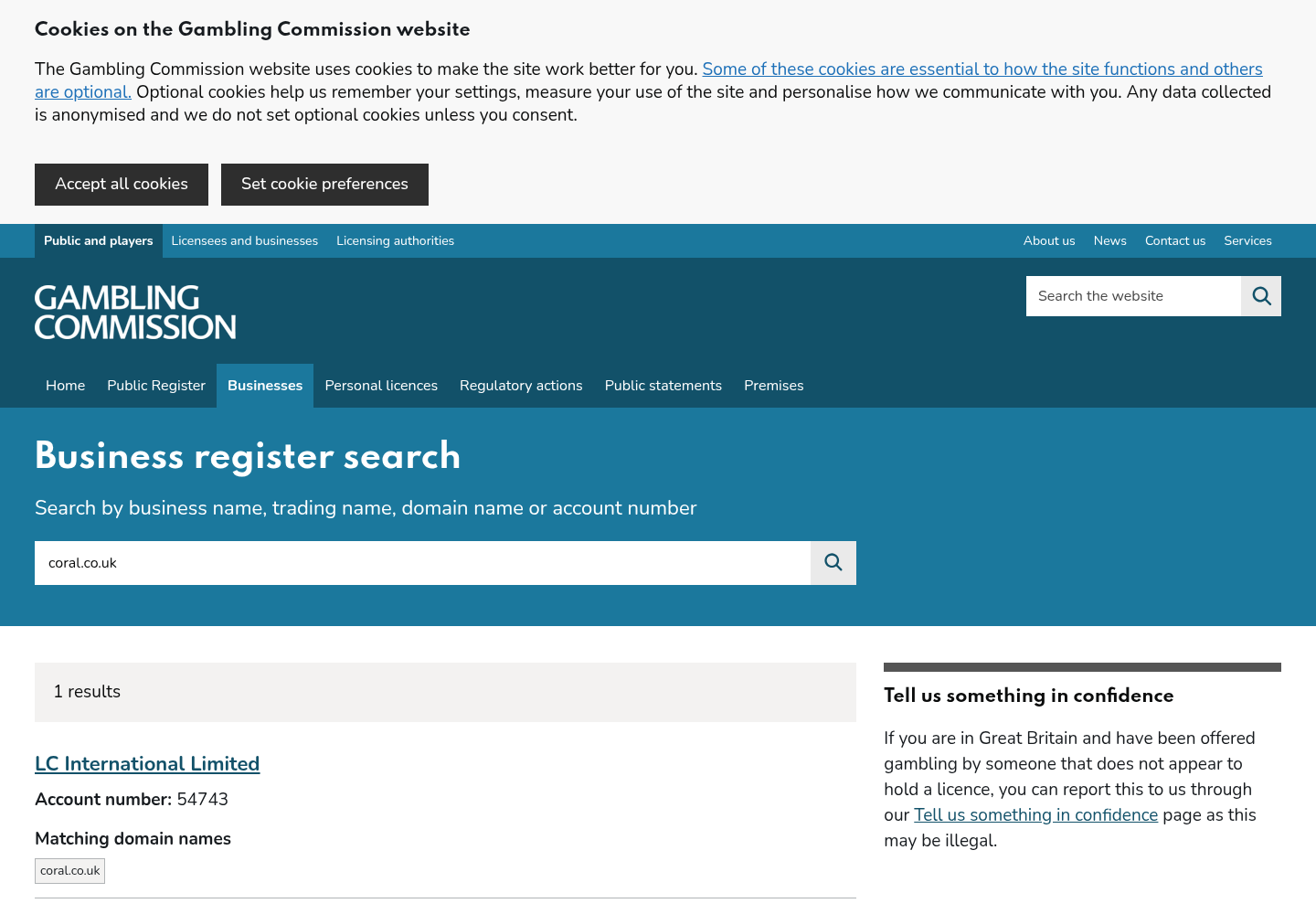
For a careful assessment, preserve the account correspondence, the withdrawal reference, dates, requested documents and payment records. Do not send additional money to unlock a withdrawal. Check the hostname shown in the browser, the operator named in the terms and the legal entity displayed during registration. The evidence supplied for this review supports an amber signal: a UK register search is available for coral.co.uk, but the record does not establish Guyana availability or licensing. The supplied complaint capture is contextual only, and no verified withdrawal test was provided.
The practical conclusion is therefore limited. The service may have a UK regulatory connection associated with the searched hostname, but the available packet does not establish that a Guyanese customer can lawfully use it, that Guyana-specific consumer protection applies, or that a withdrawal will succeed in an individual case.
What the verified packet actually establishes
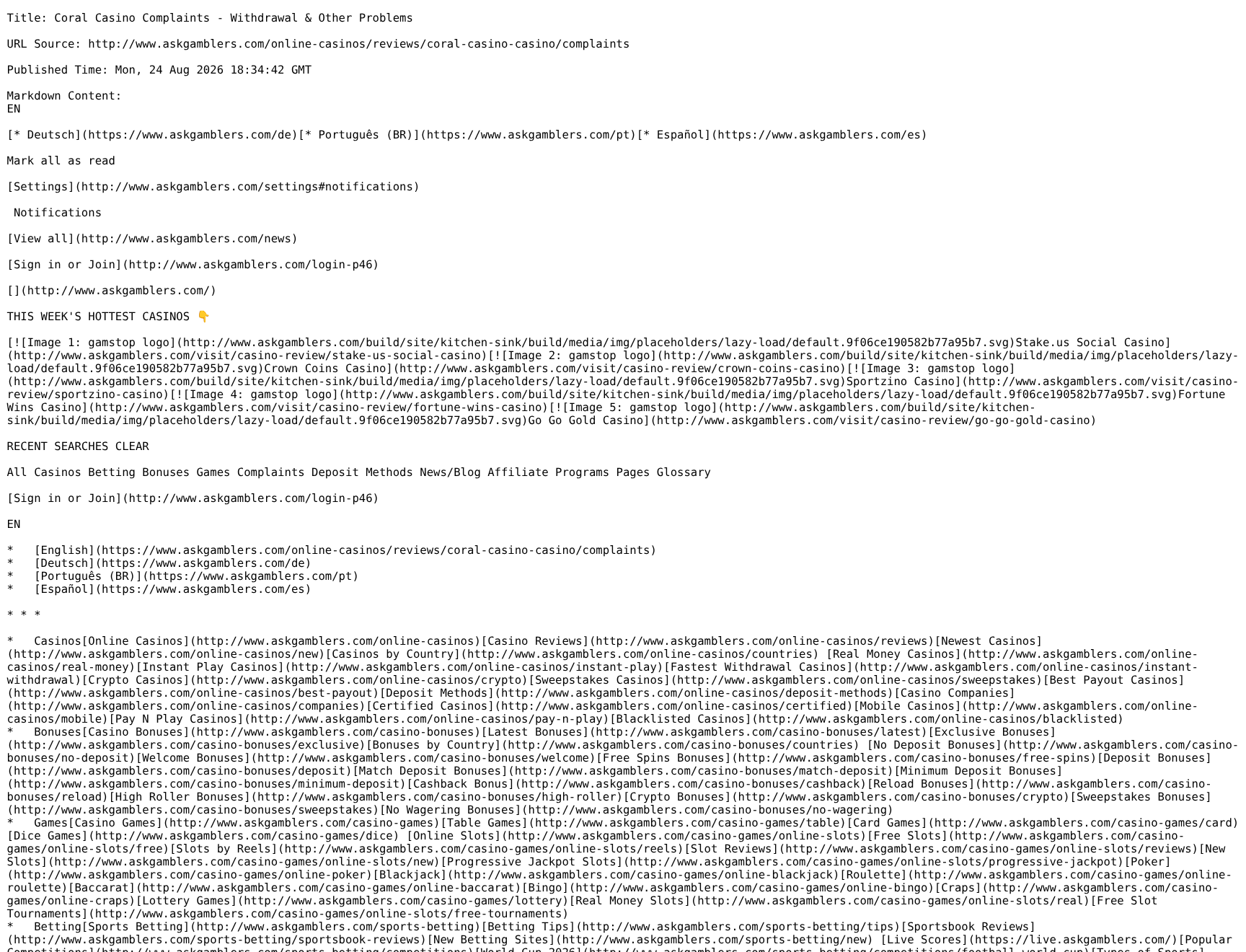
The evidence chronology is short and should not be stretched beyond its wording. On 24 August 2026, a search result from the UK Gambling Commission public register was checked for coral.co.uk. Its recorded claim refers to a search result for that hostname and an associated GB-licensed entity, while expressly stating that it does not prove a Guyana licence. The same date applies to the supplied reader-capture record identifying an AskGamblers complaint-list address. That record says that complaint submissions are allegations and that outcomes are contextual, not proof.
A locally stored brand mark was retrieved from a favicon service. It helps identify the supplied visual asset, but it is not evidence of licensing, safety or availability. Finally, a Guyanese parliamentary publication dated in the evidence packet is cited for the claim that the 2007 amendment created casino-premises and casino-operator licensing concepts. It does not, on the supplied facts, identify a current licence for this service.
| Question | Supported answer | What remains unknown |
|---|---|---|
| Which hostname was searched? | coral.co.uk | Whether a Guyanese customer is directed to that exact host or another host |
| Which operator is supplied? | LC International Limited | Whether the displayed operator matches the customer-facing terms in Guyana |
| Which regulatory source is named? | UK Gambling Commission public register | Whether a Guyana-specific authorisation exists |
| Is a licence expiry supplied? | No expiry date is supplied | Current duration, conditions and scope |
| Are withdrawals tested? | No verified withdrawal test is supplied | Processing time, documents and outcome for a Guyanese account |

Host, operator and licence: the match that matters
A legitimate-looking name is not the same as a verified legal match. Before registration or payment, compare the address in the browser with the address named in the terms, account pages and regulatory record. A hostname is the web address used by the customer; an operator is the legal organisation responsible for the service. These can be related without proving that every regional customer is covered by the same authorisation.
The supplied packet names LC International Limited as the operator and the UK Gambling Commission public register as the licence source. It does not provide a licence number, licence category, expiry date or Guyanese authorisation. The public register search is useful because it is a primary regulatory record, but its stated limitation is decisive: a GB domain entry does not establish Guyana availability or licensing. Do not convert a UK entry into a claim that the service is legal for a Guyanese resident.
For the exact record, consult the UK Gambling Commission public-register search and compare the result yourself with the host and operator shown at registration. The link is evidence context, not an assurance that the result covers Guyana.
| Matching point | Match indicated by the packet | Safe interpretation |
|---|---|---|
| Customer-facing host | coral.co.uk was searched | Confirm the browser address independently before login or payment |
| Named operator | LC International Limited | Confirm the same legal name in the current terms and account notices |
| Regulatory territory | Great Britain record | It does not answer the Guyana licensing question |
| Licence details | No number, category or expiry supplied | Treat the licence scope as unresolved |
| Regional access | No evidence supplied | Do not assume that access means lawful authorisation |
Is it a scam or legitimate service?
“Scam or legit” is a risk question, not a single fact that can be settled by a logo or one search result. The amber signal reflects open evidence. There is a primary record connected to the searched GB hostname, but it has a stated jurisdiction limit. There is also a complaint-list capture, yet complaint submissions are allegations and cannot by themselves prove misconduct. No corroborated adverse record, verified account test or Guyana authorisation was supplied.
That means the evidence does not justify calling the operator a scam. It also does not justify calling it safe, approved or legal for Guyana. A cautious customer should treat the unresolved regional position as material. Read the current terms, identify the contracting entity, check whether registration is accepted from Guyana on terms that expressly cover the customer, and confirm how disputes are handled. If those points cannot be established before payment, the rational choice is to pause.
A further warning sign would be a mismatch between the hostname, operator and payment recipient. Another would be a request to pay a fee, tax or “verification deposit” before a withdrawal is released. Those are practical risk indicators, not findings about this operator, because the packet contains no such verified event. Keep that distinction clear when recording a concern.
Payments: what is and is not known
The packet contains no verified list of payment methods, currencies, fees, minimum deposits, processing times or payment providers for a Guyanese account. It would therefore be unsafe to promise a particular card, wallet, bank transfer or local method. Payment availability can vary by country, account status, currency and the host used at the time of registration.
Before depositing, record the payment page as it appears to you, including the receiving name, currency, fee notice and any stated processing condition. Check whether the payment recipient is the same legal entity named in the terms. A third-party recipient is not automatically unlawful, but it requires a clear explanation and should not be silently substituted. Keep the transaction receipt and the account reference together.
| Payment check | Why it matters | Evidence to retain |
|---|---|---|
| Recipient name | Shows who received the funds | Receipt and payment confirmation |
| Currency and conversion | Fees can arise before play or withdrawal | Displayed rate and transaction amount |
| Deposit conditions | Bonus rules may affect available balance | Terms and acceptance record |
| Withdrawal route | The return method may differ from deposit method | Account instructions and request reference |
| Fees or extra charges | Unexpected demands increase risk | Screenshot, message and date |
No payment result is rated here. The absence of a supplied payment test is an unknown, not evidence that payments fail or work reliably. A customer should not rely on an advertisement, a brand mark or a general UK record as proof that a particular Guyanese payment route is available.
Withdrawals: build a casebook, not a conclusion
For a delayed withdrawal, create a chronological file. Start with the deposit date and amount, then record the win or balance shown, the withdrawal request, every status change, each document request and each reply. Keep original messages and avoid editing screenshots. Note the time zone and currency. If the service gives a ticket number, include it in every follow-up.
A verification request can be legitimate, especially where identity, age, payment ownership or source of funds must be checked. It can also become unreasonable if instructions keep changing or if the customer is asked to pay money before release. The supplied evidence does not establish either pattern for an actual Guyanese account. Ask for the precise outstanding requirement, the relevant term and the expected review stage, without sending documents to an unverified address.
Do not describe a complaint as a proven failure merely because it appears in a complaint list. The supplied independent capture identifies an AskGamblers complaint-list address and expressly treats submissions as allegations. You can review that context through the complaint-list record, but distinguish a reader report, an operator response and an independently established outcome.
KYC and account safety
Know-your-customer checks commonly concern identity and account ownership, but the packet does not provide the documents requested by this service, its review deadlines or its country-specific procedure. Do not infer them. Read the request inside the logged-in account or through a verified support channel, and check that the upload destination belongs to the same host and operator you intended to use.
Use a unique password and enable available account security controls. Never share a one-time code. If a message asks for a payment to “verify” identity or release winnings, stop and verify it through the account area. Redact unnecessary personal information when preserving a record for a complaint, but retain enough detail to show dates, amounts and the exact request.
KYC completion is not a licence verdict. Passing a check would not prove Guyana authorisation, and a request for documents would not prove a scam. The relevant questions are whether the request is clearly explained, proportionate to the stated account process, sent through a trustworthy channel and followed by a traceable decision.
Guyana legality and local licensing limits
The supplied Guyanese parliamentary source states that the 2007 amendment created casino-premises and casino-operator licensing concepts. That establishes the relevance of local licensing concepts, but the packet does not identify a current Guyanese licence for this service or connect the operator to one. It also does not provide a legal opinion on remote gambling, customer eligibility or enforcement.
Read the Guyanese parliamentary publication for the cited legislative context. It should not be presented as a confirmation that a particular online host is authorised. For a personal legal decision, obtain current local advice or consult the competent Guyanese authority. This dossier cannot turn a GB register entry into a Guyana licence.
| Legal question | Packet position | Responsible conclusion |
|---|---|---|
| Does a local licensing framework matter? | Yes, the cited amendment created licensing concepts | Local rules must be checked separately |
| Is a current Guyana licence identified? | No | Regional authorisation is unverified |
| Does the GB record prove Guyana legality? | No | Jurisdiction cannot be transferred by assumption |
| Does access prove approval? | No evidence says so | Availability and legality are different questions |
Clone and impersonation checks
A copied site can use a familiar name, colours or mark while directing payments elsewhere. Start with the complete browser address, including spelling and ending. Compare it with the exact host in the regulatory search, then compare the operator name, support address, terms and payment recipient. Do not trust a search advertisement simply because its visible wording looks familiar.
Check for sudden redirects, inconsistent legal names, missing terms, pressure to deposit, requests for remote-access software and messages that use a different domain. Save the address and date of any suspicious page. The supplied logo is only an identification aid; it cannot authenticate a host. A clone check also cannot prove that the original service is licensed for Guyana, so both questions must remain separate.
The safest practical rule is simple: if the host, operator and payment recipient do not align, do not deposit until the discrepancy is independently resolved. Never use a link in an unsolicited message to enter login details.
Complaints, escalation and correction path
Begin with the service’s own support route and keep a dated record of the complaint. State the account identifier, transaction reference, issue, requested remedy and deadline. Do not exaggerate or describe an allegation as a finding. If the response is incomplete, ask for the final position and the applicable dispute route.
A regulatory route depends on jurisdiction and licence scope. The supplied UK register search is a source for checking the GB record, not proof that a Guyanese customer can use a UK complaint process. The supplied complaint-list record is independent context, not an adjudication. For a local issue, seek guidance from the relevant Guyanese authority or qualified adviser; this packet does not name one.
If new dated primary evidence shows a current Guyana authorisation, a host change, an adverse official record or a verified withdrawal outcome, the assessment should be updated. Send a correction request with the source, date, precise claim and affected wording through the site’s contact route. Corrections should distinguish new evidence from an opinion or an unverified report.
Method and current risk boundary
This assessment uses only the four supplied records and their stated claims. Primary regulatory and legislative records are separated from the operator-associated visual asset and from reader complaint context. No deposit, KYC or withdrawal test was supplied, so those topics are presented as checks and unknowns rather than results. The signal is amber because the evidence is open: a GB hostname search exists, but the packet does not establish Guyana availability or licensing.
The review should be revisited if the precise host changes, the contracting entity changes, the regulator record changes or dated evidence resolves the regional question. Until then, the most defensible position is neither “scam” nor “approved”. Verify before paying, preserve records if a dispute occurs and do not send extra money to release a balance.
Read the evidence method and compare other reviewed services. If you decide to visit the supplied destination, use the Continue through the checked route only after independently checking the host, terms and Guyana-specific position.
Frequently asked questions
Is Coral Casino legal in Guyana?
The supplied packet does not establish a Guyanese licence or confirm that the service is legally available to Guyanese customers. It identifies a UK register search for `coral.co.uk`, but that record is expressly jurisdiction-limited. Treat the local legal position as unresolved and check current Guyanese requirements before depositing.
Does the UK Gambling Commission entry prove the service is legitimate for Guyana?
No. It is primary evidence for a search involving the GB hostname and an associated GB-licensed entity, but it does not prove Guyana availability or licensing. It is one part of a host-and-operator check, not a regional approval.
Are complaints against the service proven fraud?
No. The supplied complaint-list record treats complaint submissions as allegations and outcomes as contextual. A reader report can justify further checking, but it is not by itself proof of fraud, an official adverse finding or a failed withdrawal.
What should I do if my withdrawal is pending?
Record the request date, amount, status, messages, document requests and reference number. Ask support to identify the exact outstanding requirement and applicable term. Do not pay an extra fee to release funds, and preserve the correspondence if you escalate the matter.
What documents might KYC require?
The packet does not specify this service’s documents or deadlines, so no precise list should be assumed. Follow only a clearly identified account procedure, verify the host and upload channel, and do not share one-time codes or send documents in response to an unverified message.
How can I spot a clone?
Compare the complete browser address with `coral.co.uk`, the operator name, terms, support details and payment recipient. Watch for spelling changes, unexpected redirects, inconsistent legal names and pressure to deposit. A matching brand mark alone cannot authenticate a host.