
Betfair scam or legit in Guyana? Licence and risk review

What the dated evidence shows first
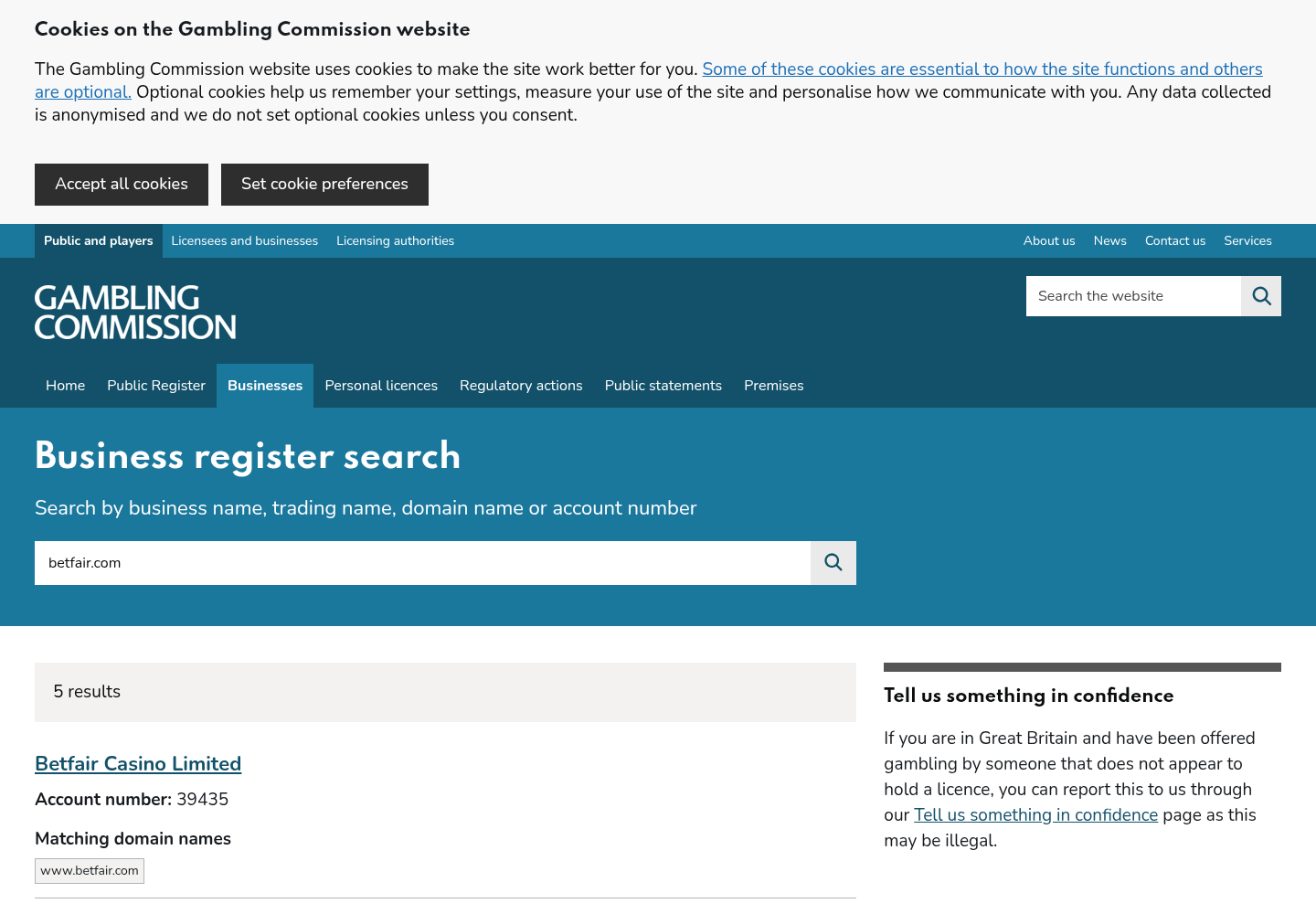
The supplied packet was checked on 24 August 2026. Its central finding is limited but important: multiple Great Britain entities appear to list the domain betfair.com in the UK Gambling Commission public register, while no exact-domain Guyana record was located. The packet does not provide a register-entry date, licence number, expiry date, or a complete entity-to-domain match. It therefore does not support a green conclusion that the service is licensed for Guyanese customers.
The appropriate signal is amber, with an open-evidence basis. Amber is not a finding that the service is a scam. It means that some licensing evidence exists in the supplied material, but the available record does not establish the precise domain, operating entity and Guyana permission as one verified chain.
The chronology available for this review is therefore narrow:
| Date | Evidence event | What it establishes | What remains open |
|---|---|---|---|
| 24 August 2026 | The supplied evidence packet was checked | The packet records a UK register search context for betfair.com, a complaint-list capture, and two Guyana legal sources | The actual register change date, licence number, expiry, named account holder and Guyana authorisation |
| 24 August 2026 | Guyana legal materials were checked | Guyana law contains casino-premises and casino-operator licensing concepts, including application and suitability rules | Whether this online service, its domain or its operator holds a relevant Guyanese approval |
| 24 August 2026 | Complaint capture was identified | Reader complaints can be reviewed as allegations and contextual signals | Whether any complaint was upheld, resolved, or connected to a verified legal entity |
The evidence does not include a withdrawal test, a payment test, a KYC test, a customer-service test, or a confirmed Guyana account journey. Those omissions matter more than a polished interface or a familiar name.
Domain, host and operator identity
The exact domain supplied for this dossier is betfair.com. The named operator is “Betfair Casino Limited / PPB group entities”. That wording describes more than one possible corporate entity rather than identifying one confirmed company responsible for every customer, payment, product and jurisdiction. A domain is not itself a licence holder, and a brand name is not itself a legal person.
The supplied evidence limits state that multiple Great Britain entities list the domain and that no exact-domain Guyana record was located. This creates an identity-matching problem with three separate questions:
- Is
betfair.comthe precise host a customer is using, rather than a redirected, regional or copied address? - Which legal entity accepts the customer’s account and holds responsibility for balances and withdrawals?
- Does that entity have permission to provide the relevant gambling service to a customer located in Guyana?
The packet answers only the first question as a supplied domain label. It does not provide the answer to the second or third. “PPB group entities” should therefore not be treated as a single licence holder. The operating entity must be checked in the account terms, registration flow, payment instructions and any regulator record, with the wording and date recorded.
| Identity item | Supplied position | Verification limit |
|---|---|---|
| Brand | Betfair | A brand does not prove the contracting company |
| Exact domain | betfair.com | No exact-domain Guyana record was located |
| Named operator | Betfair Casino Limited / PPB group entities | More than one entity is indicated; no single customer-contracting entity is confirmed |
| UK regulator reference | UK Gambling Commission public register | The packet does not supply a licence number, register extract or expiry date |
| Guyana authorisation | Not established in the packet | No exact-domain Guyana record was located |
A safe check is to compare the legal name shown before registration with the name shown in the terms, cashier, withdrawal confirmation and complaint response. A mismatch is not automatic proof of fraud, but it is a reason to pause and preserve records.
Is Betfair legal in Guyana?
The supplied Guyana materials establish a legal framework, not a licence for this service. The 2007 amendment is described in the packet as creating casino-premises and casino-operator licensing concepts. The consolidated law is described as setting application and suitability rules for casino premises and operator licences. Those are relevant primary sources for understanding the legal scope, but neither supplied claim confirms that betfair.com or a named Betfair entity has a Guyanese licence.
The legal answer must consequently be expressed in two parts. First, Guyana has legislation addressing casino premises and operators. Second, this evidence packet does not prove that the online service is authorised for a customer in Guyana. It would be unsafe to turn the absence of a located record into a definitive statement that the service is illegal, just as it would be unsafe to describe the service as locally licensed.
The distinction between a foreign licence and local permission is important. A UK register entry, even if current and correctly linked to the domain, would concern the scope of that UK authorisation. It would not automatically establish permission under Guyanese law. The relevant product, customer location, contracting entity and licensing category would still need to match.
| Question | Evidence-led answer | Practical consequence |
|---|---|---|
| Does Guyana have gambling licensing rules? | The supplied primary materials describe casino-premises and operator licensing concepts | Check the applicable local category rather than relying on a foreign register |
| Is a Guyana licence for this domain shown? | No exact-domain Guyana record was located | Treat local authorisation as unconfirmed |
| Is a UK reference the same as Guyana permission? | Not established | Do not use a foreign reference as automatic proof of local legality |
| Is the service proven illegal? | No | The packet supports an open-evidence amber signal, not a definitive adverse finding |
For a legal decision affecting money or access, use the competent Guyanese authority and obtain a current, entity-specific answer. This dossier records the supplied evidence boundary; it is not a legal opinion.
Licence chronology and the missing link
The editorial focus is chronology because the packet records a search context but not the underlying sequence of register changes. The supplied official capture points to a UK Gambling Commission public-register search for betfair.com, and the evidence claim says that multiple Great Britain entities list the domain. However, the packet contains no dated change, no historical extract and no licence expiry. It is therefore impossible to state when a listing began, whether it changed, or which entity held responsibility at a particular time.
That missing chronology affects interpretation. A current-looking search result may not show the historical position on the date of a deposit, withdrawal, restriction or complaint. A domain may also be associated with different permissions or entities at different times. Without a dated entry, the reviewer cannot safely connect a customer event to a specific licence record.
| Chronology field | Result in supplied packet | Why it matters |
|---|---|---|
| Search context | UK Gambling Commission public-register search for betfair.com | Shows where the official capture was directed |
| Register change date | Not supplied | Cannot date a licence or entity transition |
| Licence number | Not supplied | Cannot uniquely identify the permission |
| Expiry date | Blank in the packet | Current status cannot be confirmed from the supplied fields |
| Named legal entity | Multiple Great Britain entities are indicated | Cannot select one contracting operator |
| Guyana status | No exact-domain record located | Local permission remains unresolved |
The correct wording is not “licensed everywhere” and not “unlicensed everywhere”. It is that the supplied record supports a UK-register search context but leaves the exact entity, date, licence scope and Guyana position open.
Scam-or-legit assessment
The question “scam or legit?” combines identity, licensing, payment performance and customer experience. The packet does not contain enough evidence to answer it with a binary label. The amber signal means that the available information is neither a verified clean bill of health nor an official adverse finding.
There is a legitimate-looking evidence trail in the limited sense that an official-register search capture is supplied and that primary Guyana legal materials are identified. That does not prove that a person in Guyana can lawfully register, deposit, play or withdraw through this domain. It also does not prove that every page using the brand is genuine.
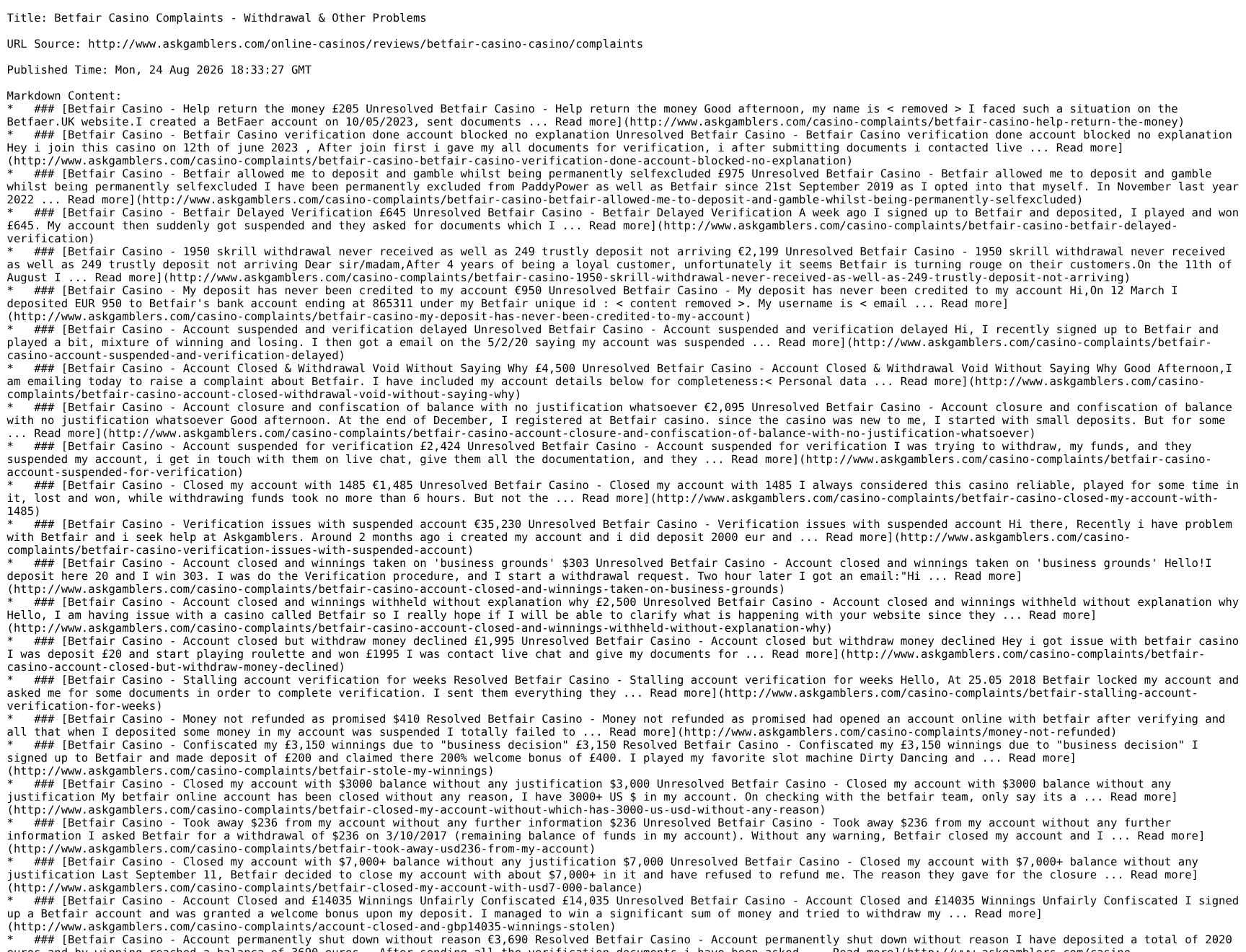
The complaint capture should be read cautiously. The supplied claim identifies an AskGamblers complaint-list URL and expressly says that complaint submissions are allegations and outcomes are contextual, not proof. A complaint headline, user description or unresolved status cannot establish fraud, non-payment or unlawful conduct without a dated and competent supporting record. Conversely, a complaint list can alert a customer to preserve evidence and ask precise questions before depositing.
| Signal | What would normally support it | Position here |
|---|---|---|
| Green | Current primary evidence matching the precise domain, entity and relevant local permission | Not reached |
| Amber | Open, incomplete or conflicting evidence without an official adverse finding | Applies to this dossier |
| Red | Official adverse action or corroborated documented adverse evidence | Not established by the supplied packet |
Do not treat the amber signal as approval. Before using the service, confirm the contracting entity, applicable jurisdiction, available payment route, withdrawal conditions and complaint channel. Avoid sending funds merely to test an unresolved operator identity.
Payments and account funding
No payment method is supplied in the verified packet. No deposit test, payment processor record, fee schedule, currency confirmation or Guyana-specific cashier evidence is available. It would therefore be inaccurate to list cards, bank transfer, electronic wallets, cryptocurrency or any other method as available.
A customer should distinguish the name displayed in a cashier from the legal operator. A processor name may be an intermediary, while a payment descriptor may be shortened or different from the brand. Before funding an account, record the displayed currency, minimum and maximum amounts, fees, identity requirements, and any statement that deposits must come from an account in the customer’s own name.
| Payment question | Verified answer | What to check before funding |
|---|---|---|
| Which methods are available in Guyana? | Unknown | The live cashier and terms for the customer’s location |
| Which currency is accepted? | Unknown | Currency, conversion rate and any conversion charge |
| Are deposits reversible? | Unknown | Refund and chargeback wording, without assuming a chargeback outcome |
| Is third-party funding allowed? | Unknown | The account-name and source-of-funds rules |
| What evidence should be kept? | No test was supplied | Confirmation, transaction reference, date, amount and payment descriptor |
Do not rely on a promotional statement as proof that a method will remain available for withdrawals. Payment availability can depend on location, verification status, product and risk controls.
Withdrawals, KYC and account restrictions
The packet contains no withdrawal test and no verified customer journey. There is no supported conclusion about processing time, successful payment, rejected withdrawal, confiscated balance or unresolved payout. Any such statement would go beyond the evidence.
Know-your-customer checks are also unverified. The dossier cannot claim which documents are requested, when they are requested, how long review takes, or whether source-of-funds checks apply. A request for identity evidence is not by itself proof of wrongdoing; it can be part of compliance controls. At the same time, a customer should understand what is requested and where documents are uploaded before providing sensitive material.
A careful record should include the registration date, exact host, contracting entity, deposit confirmation, terms version, game or wager reference, withdrawal request, verification messages and support ticket. Keep original files and timestamps. Do not edit screenshots to remove context. Redact unnecessary personal numbers before sharing records with a complaint body.
| Event | Evidence available here | Safe record to retain |
|---|---|---|
| Registration | Not tested | Host, date, legal entity and accepted terms |
| KYC request | Not supplied | Request, document category, deadline and upload destination |
| Deposit | Not tested | Amount, currency, reference and payment descriptor |
| Withdrawal | No withdrawal test exists | Request time, amount, status and every response |
| Restriction or closure | Not supplied | Notice, stated reason and balance information |
The absence of a test is an unknown, not evidence that withdrawals fail. It does mean that this dossier cannot promise a successful payout.
Complaint route and user reports
The supplied complaint source is a reader complaint list. Its role is contextual: it may show allegations or reported disputes, but the packet does not establish that any particular complaint was upheld, resolved in a customer’s favour, or linked to the correct legal entity. Do not present a user report as a regulator finding.
A sensible complaint sequence begins with the operator’s support channel shown inside the authenticated account or terms. State the account identifier, date, amount, transaction reference, requested remedy and a clear deadline. Ask the operator to identify the contracting entity and the rule relied upon for any restriction. Keep the exchange factual and avoid publishing personal documents.
If the response is incomplete, use the relevant formal complaint or regulatory route after checking jurisdiction and eligibility. The supplied packet does not identify a Guyanese online-gambling complaint authority for this domain. It also does not establish that the UK regulator would handle an individual dispute or order a payment. A regulator’s role and a payment dispute process are not automatically the same.
| Complaint stage | Record to provide | Limitation |
|---|---|---|
| Operator support | Account, transaction and requested remedy | The correct entity and channel are not verified here |
| Formal escalation | Full chronology and prior replies | Jurisdiction and eligibility must be checked |
| Regulatory enquiry | Precise licence and entity details | No licence number is supplied |
| Payment dispute | Processor record and transaction evidence | A payment provider’s process does not decide gambling legality |
The complaint capture may be opened as evidence context at the identified complaint-list record. Read each entry as an allegation unless a competent dated record establishes more.
Clone checks and practical safety controls
A genuine-looking logo does not authenticate a host. The supplied logo is included for identification only; it is not evidence of ownership or authorisation. Check the spelling of the domain character by character, including the ending after the final dot. Be cautious with links received through messages, advertisements or search results that use extra words, hyphens, unusual country endings or lookalike characters.
Before logging in, compare the host shown in the browser with the exact domain under review. Do not assume that a redirect proves a clone is absent. Record the final host, the legal entity shown in the terms, the privacy contact and the withdrawal section. A mismatch between these items should be treated as an unresolved risk.
Never provide a password, one-time code or identity document to a person who contacts you privately claiming to represent the service. Use the account’s established support route. Use a unique password and enable available account security controls. Do not reuse payment credentials or permit another person to operate the account.
Evidence method, limits and correction path
This review separates primary legal or register material from operator statements and user-context material. The Guyana legal sources are primary materials for the legal framework. The official-register capture is an evidence record directed to a regulator search, but the supplied packet does not provide the underlying dated entry, licence number or full extract. The complaint-list capture is contextual user-report material even though the packet labels its evidence tier as primary; its stated claim expressly limits complaints to allegations and context.
The method is deliberately narrow. It asks whether the precise host, contracting entity, relevant licence and Guyana scope can be matched. It does not infer a licence from a logo, a brand from a domain, or successful operation from a complaint page. It also does not infer a failed withdrawal from the absence of a withdrawal test.
The result should be corrected if a dated competent record supplies the missing link. Useful correction evidence would identify the exact domain, named legal entity, licence or authorisation number, relevant jurisdiction, status date and scope. A customer correcting a factual error should provide the original source, access date, disputed sentence and replacement evidence. Material updates should preserve the original chronology rather than silently changing it.
For the wider review process, see the evidence methodology and the editorial policy. Questions about a factual correction can be sent through the contact route. These internal routes do not replace a regulator or formal complaint process.
Bottom line for a Guyanese customer
The supplied evidence does not establish that betfair.com is licensed for Guyana, nor does it establish a single exact operator entity for every customer. It does identify a UK public-register search context, a Guyana legal framework and a complaint-list capture. Those facts justify careful checking, not a definitive scam accusation or a local-legality guarantee.
The amber result is therefore practical: pause before depositing until the host, contracting entity, licence scope, payment route and withdrawal conditions are clear. If money has already been sent, preserve confirmations and correspondence, request a written explanation from the operator, and identify the payment provider. Do not publish allegations as settled facts. If the missing evidence becomes available, the conclusion should be revisited against the date and exact entity.
If, after those checks, you choose to continue, use Continue through the checked route, and review the terms before committing funds. The route is not evidence of licensing, a promise of approval, or a guarantee of payment.
parliament.gov.gy · mola.gov.gy
Frequently asked questions
Is Betfair a scam in Guyana?
The supplied evidence does not prove that Betfair is a scam. It also does not verify a Guyana licence for `betfair.com`, a single contracting entity, or successful withdrawals. The correct signal is amber because the evidence remains open.
Is Betfair legal in Guyana?
The packet confirms that Guyana has casino-premises and operator-licensing concepts, but it does not show an exact-domain Guyana record for `betfair.com`. Local legality and authorisation therefore remain unconfirmed rather than proven either way.
Which company operates Betfair?
The supplied operator field says “Betfair Casino Limited / PPB group entities”. Because multiple entities are indicated, the packet does not identify one confirmed company responsible for every customer. Check the legal entity in the terms and account journey.
Does a UK register reference prove Guyana permission?
No. A UK register reference would concern the scope of the relevant UK permission. It does not automatically establish permission to serve a customer in Guyana. The domain, entity, product and jurisdiction must be matched separately.
Can I trust the complaints shown online?
Treat the supplied complaint list as contextual user-report material. Complaint submissions are allegations, and the packet does not establish that any particular report was upheld or resolved. A complaint can justify further checking but is not, by itself, proof of fraud or non-payment.
Are payments and withdrawals tested here?
No. The packet contains no payment test and no withdrawal test. Payment methods, fees, processing times, KYC requirements and payout outcomes must therefore be treated as unknown until supported by dated, relevant evidence.
How can a factual error in this review be corrected?
Provide the disputed statement, its date, the exact domain and legal entity, and a dated competent source that supports the correction. Preserve the original chronology and send the material through the contact route so the evidence can be assessed rather than relying on an unsupported assertion.